Beauty
Skincare in Dubai: the routine that works here and the mistakes I made
The best skincare routine for Dubai's climate hydrates instead of stripping, uses SPF 50 every day and keeps actives to a minimum. Most Dubai skin problems are dehydration wearing an oily disguise.
The best skincare routine for Dubai's climate is a short one: hydrate instead of stripping, wear SPF 50 every day and reapply it every 2 to 3 hours when you are outdoors, and use fewer actives than you think you need. Almost every skin complaint I get asked about here, the shine by 11am, the tightness at your desk, the dullness by Thursday, is dehydration wearing an oily disguise. Fix the water loss and most of the rest calms down on its own. Here is the routine, the mistakes, and what to expect at a clinic.
What does Dubai's climate actually do to your skin?
Four things, all at once. The sun is the obvious one: the UV index here sits at 11 or higher for much of the year, which the World Health Organization files under "extreme". Then there is the air conditioning, which runs all day, everywhere, and pulls water out of your skin the same way it pulls it out of the air. Your skin notices the water loss and pushes out more oil to compensate, so you end up shiny and tight at the same time. That is dehydrated oily skin, the default Dubai face.
Add hard water, which leaves a lot of people squeaky and tight after cleansing, and sweat, which sits under SPF and makeup from the moment you leave the building. The instinct is to scrub it all away with something foaming and strong. That is the wrong move. Strip the oil and the skin makes more. Add water and the oil settles.
What should a morning skincare routine look like in Dubai?
Mine is four steps.
- A gentle cleanser. Sulfate-free, lukewarm water, once. If your skin squeaks afterwards, the cleanser is too strong for this climate.
- One serum. Vitamin C or niacinamide in the morning. Niacinamide is the safer pick if your skin is reactive and it helps with oil. One, not both.
- A light hydrator. A hyaluronic acid serum pressed into damp skin, or a gel moisturiser. This is the step oily-skinned people skip, and it is the step that fixes oily skin.
- SPF 50. Two fingers' worth for face and neck, then wait a few minutes before makeup.
No toner unless you enjoy one, no essence, no face oil in the morning. The heavier you go before 8am, the more slides off by noon.
What should the night routine be?
Night is when you do the work. If you have worn SPF or makeup, double cleanse: a balm or micellar water first to dissolve it, then your gentle cleanser. Then one active, a few nights a week, never stacked. A gentle retinol two or three nights a week, or a mild exfoliating acid once or twice a week, not both until your skin is used to each on its own. On the other nights, just hydrate. Finish with a moisturiser that matches how your skin feels: gel in peak summer, something richer with ceramides in the cooler months.
If your skin stings when you apply moisturiser, the actives are winning. Stop them for a week.
Which sunscreen is best for Dubai?
The one you will actually wear every day: a light, no-white-cast SPF 50 that sits well under makeup. For South Asian skin the white cast is the usual reason people give up on sunscreen, so texture matters more than the number on the tube. Prices are roughly what I found at the time of writing; check before you buy.
- Biore UV Aqua Rich SPF 50+. Watery, vanishes instantly, no cast. Roughly AED 45 to 100 depending on the size and seller, mostly online.
- La Roche-Posay Anthelios UVMune 400 Oil Control SPF 50+. A matte fluid that behaves under a full face and is in every pharmacy. Roughly AED 60 to 90.
- Eucerin Sun Oil Control Gel-Cream SPF 50+. A similar matte finish aimed at acne-prone skin, in a similar price bracket.
- Kosas DreamBeam SPF 40. A tinted mineral sunscreen with a glow, for low-makeup days. Around AED 200 to 240. Not my pick under a heavy base on very oily skin.
Reapply every 2 to 3 hours when you are outdoors. An SPF mist or powder over makeup is less thorough than the morning layer but far better than nothing. And the fact that changed my habits: UVA passes through glass, so the drive down Sheikh Zayed Road and the desk by the window both count. Neck, ears and hands too.
The mistakes I made
I used to blame my skin. It was the habits.
- Over-exfoliating to fix dullness. Another acid, another scrub, and a barrier that stung in the shower. I cut back to once or twice a week. Tight or pink afterwards means too much.
- Treating oil as something to strip. Foaming cleanser, several washes a day, no moisturiser. The oil got worse. Twice a day, sulfate-free, plus a gel moisturiser, and it calmed down.
- Skipping SPF for short trips. Twenty minutes in the car, five days a week, is a lot of UVA through a windscreen.
- Hot water. It feels wonderful and it strips everything your barrier needs. Lukewarm, always.
- Forgetting everything below the jaw. My body took the same sun, pool and AC and got none of the care. That has its own piece: why body skin gets so dry in Dubai.
What I actually use
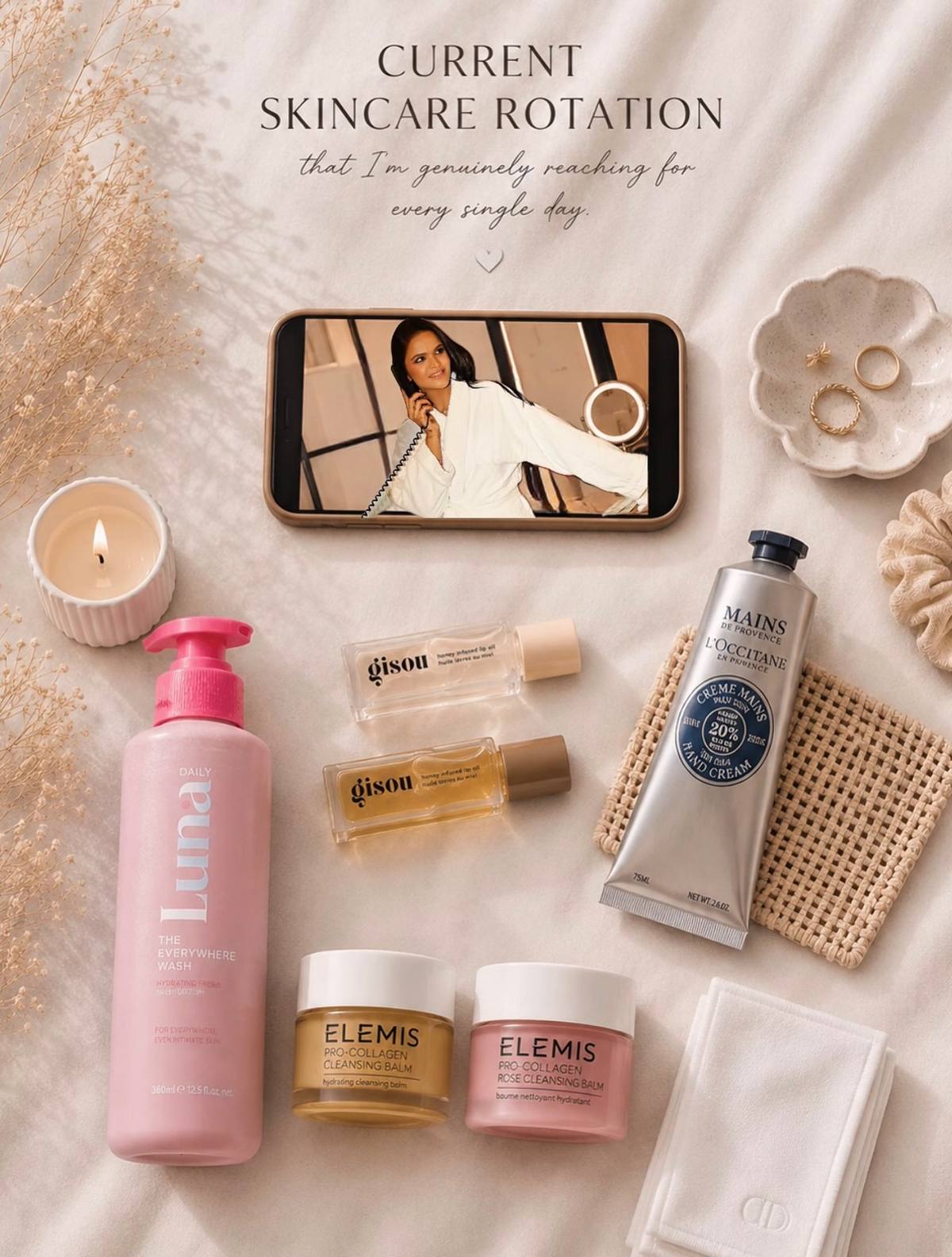
I shared my current top five skincare essentials on Instagram in June, no gatekeeping: Elemis, Dior Beauty, Gisou, Luna Daily and L'Occitane. None of them is a miracle. They are the five that stayed on the shelf through a Dubai summer, which is the only test that matters here. Elemis also makes the body cleansing balm I posted about in August, which turns milky in the shower instead of foaming, exactly the texture this climate asks for.
Other things from my feed that earn their place:
- Erborian CC Cream. I was at the Sephora Middle East launch night for the updated formula in November. It has SPF 30 and centella in it and gives a light, even base that does not look like makeup. On a beach day it goes over a proper SPF 50, because SPF 30 in a CC cream is not enough on its own here.
- Elizabeth Arden Hyaluronic Acid + Peptides Capsules. Single-dose capsules of a hydrating serum. The format is good for travel and the texture is light enough for summer.
- Bioderma Sebium range. If you are oily or acne-prone, this is the pharmacy line I would start with. The micellar water and the gel cleanser are the two to buy first. Gentle, affordable, sold everywhere.
- Kosas DreamBeam. Moisturiser, sunscreen and primer in one on glowy days. Sunlit is the sheer-tinted, warmer shade.
Disclosure: Elemis, Dior Beauty, Gisou, Luna Daily, L'Occitane, Erborian, Elizabeth Arden, Bioderma and Kosas gifted these products or are brands I have worked with, and the clinic treatment below was gifted. My opinion is my own.
When should you go professional, and what does a facial cost in Dubai?
Home care does most of the work. A professional treatment makes sense for a specific problem products are not shifting: sun pigmentation, texture, congestion that keeps coming back. Roughly, at the time of writing:
| Treatment | Good for | Rough price per session |
|---|---|---|
| HydraFacial or hydrating facial | Dullness, dehydration, congestion | AED 300 to 900 at most places; deals under AED 250, top clinics over AED 1,000 |
| Chemical peel, as a course | Sun pigmentation, uneven tone | From roughly AED 500 |
| Microneedling | Scars, pores, early lines | From roughly AED 1,000 |
| Oxygen or LED add-ons | A pre-event glow, calming | Varies, often bundled |
The spread on HydraFacial is so wide because a salon with a basic machine and a clinic with a doctor on site are selling different things. Under about AED 250 you are usually getting a quick version. For anything medical grade, peels, needling, injectables, go to a clinic licensed by the Dubai Health Authority and have a consultation first. A good place will talk you out of the expensive option if you do not need it.
The one clinic treatment I have had myself is Rejuran, the salmon DNA skin booster, at Shookra Aesthetics in June last year. It was a gifted treatment, so read this as one honest visit, not years of loyalty. It was gentler than I expected and close to painless, and my skin looked smoother and had a glow in the days after. If texture is your concern it is worth asking about. I am not a doctor; ask the clinic what is realistic for your skin, and do not trust anyone's before and after, including mine.
A hydrating facial every four to six weeks is plenty for most people. Peels and microneedling are spaced courses. After any of them, keep it boring for a week: gentle cleanser, hydration, SPF 50, no actives. Freshly treated skin pigments fast in this sun.
What I would skip
Ten-step routines. Scrubs with grit. Flash-deal facials from a place you have never heard of; the price is low because the machine or the hands are. And anything that promises to fix pigmentation in a week. Pigmentation here is a sunscreen problem first and a treatment problem second.
If your makeup is sliding off by noon, that is usually a skin-prep problem, and the fix is in how to stop makeup melting in Dubai heat. For a day of being looked after rather than treated, start with my list of the best spas in Dubai.
All my Beauty guides · Brands: work with me on beauty.